
Vitamin E in Cosmetics: Structure, Effects, Stability, and Regulatory Classification
Brief Definition: Vitamin E is a collective term for a group of lipophilic antioxidants belonging to the tocopherol and tocotrienol families. In cosmetic formulations, vitamin E oil is primarily used as a free radical scavenger, to protect lipids from oxidation, and to stabilize sensitive active ingredients. The most biologically active form is alpha-tocopherol. According to the EU Cosmetics Regulation (EC) No. 1223/2009, vitamin E is permitted without specific concentration restrictions, provided that product safety is assessed in the safety report.
What is vitamin E from a chemical perspective?
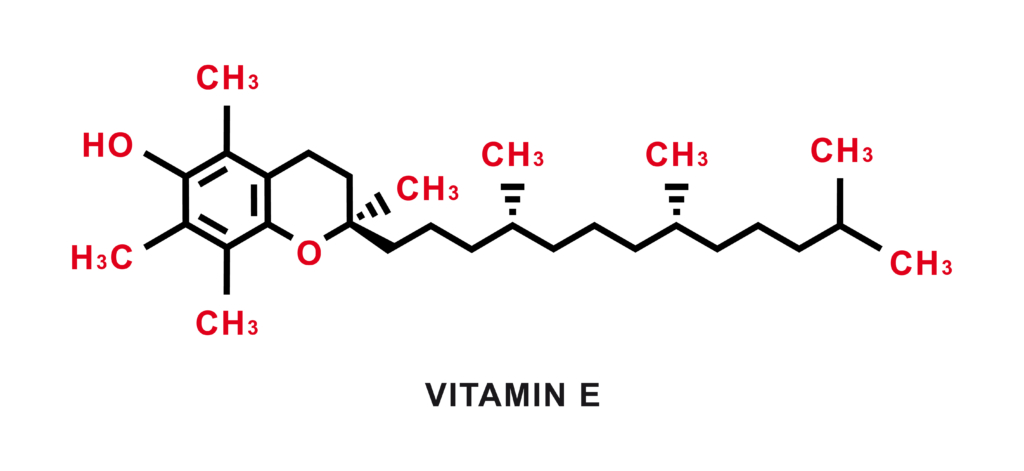
Vitamin E refers to a group of structurally related chromanol derivatives with a lipophilic side chain.
Basic structure:
- Chromanol ring (antioxidant activity)
- Lipophilic side chain (membrane affinity)
- Fat-soluble (logP approx. 9–12, depending on the derivative)
Physical and chemical properties (α-tocopherol)
- INCI: Tocopherol
- CAS: 59-02-9
- Molecular weight: 430.7 g/mol
- Physical state: viscous, yellowish oily liquid
- Melting point: approx. 2–3 °C
- Sensitive to light and oxidation
- Solubility: soluble in oils, insoluble in water
Vitamin E oil is typically used in concentrations of 0.1–1.0%, but its antioxidant protective functions often begin as early as 0.05–0.2%.
Which forms of tocopherol are cosmetically relevant?
The biologically and cosmetically relevant forms differ in the methylation of the chromanol ring.
𝛼-Tocopherol (Alpha-Tocopherol)
Alpha-tocopherol is the most biologically active form and the variant preferred by the human body for storage.
Technically relevant:
- Highest vitamin E activity
- Strong lipid radical scavenger
- Frequently used as an antioxidant in skin care products
- Sensitive to oxidation → Combination with ascorbyl derivatives is common
β-Tocopherol (Beta-Tocopherol)
Beta-tocopherol has lower biological activity than alpha-tocopherol.
Practical application:
- It is rarely used in isolation and is usually a component of natural tocopherol mixtures
γ-Tocopherol (Gamma-Tocopherol)
Gamma-Tocopherol is frequently found in vegetable oils and possesses good radical-scavenging properties.
Practical application:
- Component of natural vitamin E concentrates
- Good stabilizer for vegetable oils
- Relevant in natural cosmetics
𝛿-Tocopherol (Delta-Tocopherol)
Delta-Tocopherol exhibits lower vitamin activity but possesses antioxidant properties.
Practical application:
- Component of tocopherol mixtures
- Functionally acts as an antioxidant
What distinguishes tocotrienols from tocopherols?
Direct answer: Tocotrienols belong to the vitamin E family, but unlike tocopherols with their saturated phytyl side chain, they possess an unsaturated isoprenoid side chain.
Technical classification:
- Higher membrane mobility
- Different penetration characteristics
- Potentially stronger antioxidant activity in lipid membranes
- Even more limited penetration into the cosmetic market
How does vitamin E work in the skin?
Vitamin E acts as a lipophilic antioxidant, protecting cell membranes from lipid peroxidation and reducing oxidative stress.
The mechanism involves the neutralization of free radicals, the interruption of lipid peroxidation chains, and the stabilization of barrier lipids. There is a synergy with vitamin C.
In vivo results
- UV-induced oxidative stress: Topical application of 5% α-tocopherol significantly reduced UV-induced skin damage after 4 weeks (Burke et al., 2000).
- Erythema reduction: A combination of vitamins C and E significantly reduced UV-induced erythema compared to placebo (Lin et al., 2003).
- Barrier strengthening: Topical application showed a reduction in TEWL in dry skin after two to four weeks (Thiele et al., 1998).
Vitamin E oil is therefore frequently used in the following products:
- Anti-aging emulsions
- Sunscreen formulations
- After-sun products
- Barrier care
- Scar and regenerative care
Which derivatives are most commonly used in cosmetics?
Direct answer: In addition to free tocopherol, more stable esters such as tocopheryl acetate or tocopheryl linoleate are used.
Typical INCI:
- Tocopherol
- Tocopheryl Acetate
- Tocopheryl Linoleate
- Tocopheryl Succinate
Advantages of esters:
- More oxidation-stable
- Less intrinsic discoloration
- Better formulability
Free vitamin E oil, on the other hand, exhibits higher direct antioxidant activity.
What regulatory aspects must be considered?
Vitamin E is not restricted under EU Regulation (EC) No. 1223/2009, but must be evaluated toxicologically in the safety report.
Practical considerations:
- Document purity requirements (COA, heavy metals)
- Check peroxide value of raw material
- Stability testing ≥ 3 months (40 °C/75% RH)
- INCI-compliant declaration
- Oxidation protection through suitable packaging (airless, light-protected)
What alternatives or innovative options are available?
In addition to classic tocopherols, specialized antioxidants can be used.
Examples:
- Cosactive TocoPower: high-purity, formulation-tested tocopherol concentrate with optimized stability
- Cosactive TOCAS: synergistic antioxidant system for stabilizing sensitive lipid formulations
Such raw materials are particularly suitable for:
- high-concentration anti-aging products
- natural cosmetics containing oils prone to oxidation
- active ingredient combinations with retinoids
Conclusion: Vitamin E Oils
For rapid market entry, Tojo Cosmetics GmbH offers EU-compliant white-label cosmetic products with formulations containing vitamin E. These enable small-batch production starting from low quantities without the need for an in-house development phase.
Cosactive GmbH offers formulation-tested active ingredients such as “Cosactive TocoPower” or “Cosactive TOCAS” in container sizes suitable for developers.
If you would like custom products containing tocopherols or their latest innovative derivatives, please contact our partner Cosmacon. They will be happy to advise you on novel, innovative products.
FAQ
Is vitamin E oil comedogenic?
At typical usage concentrations (≤ 1%), tocopherol is considered non-comedogenic, although the overall formulation is decisive.
Is tocopheryl acetate more effective than tocopherol?
Tocopheryl acetate is more stable but must be enzymatically hydrolyzed to tocopherol.
Can vitamin E oxidize?
Yes. Oxygen, light, and heat accelerate oxidation, which is why suitable packaging is required.
Is vitamin E suitable for natural cosmetics?
Yes, provided it is of plant origin and has been evaluated in accordance with ISO 16128.
What should the dosage of vitamin E be?
Typically 0.1–1.0%, although antioxidant stabilization is possible starting at 0.05%.
Is vitamin E a preservative?
No, while it protects lipids from oxidation, it does not possess sufficient antimicrobial activity.
Sources
Thiele JJ et al. (1998). Vitamin E in human skin: organ-specific physiology and considerations for its use in dermatology.
Molecular Aspects of Medicine.
https://doi.org/10.1016/S0098-2997(98)00009-7
Burke KE et al. (2000). Effects of topical vitamin E on ultraviolet radiation-induced damage in human skin.
Journal of the American Academy of Dermatology.
PubMed: https://pubmed.ncbi.nlm.nih.gov/10688716/
Lin JY et al. (2003). UV photoprotection by combination topical antioxidants vitamin C and vitamin E.
Journal of the American Academy of Dermatology.
https://pubmed.ncbi.nlm.nih.gov/14639373/
Regulation (EC) No. 1223/2009 of the European Parliament and of the Council on cosmetic products.
https://eur-lex.europa.eu/legal-content/DE/TXT/?uri=CELEX:32009R1223