
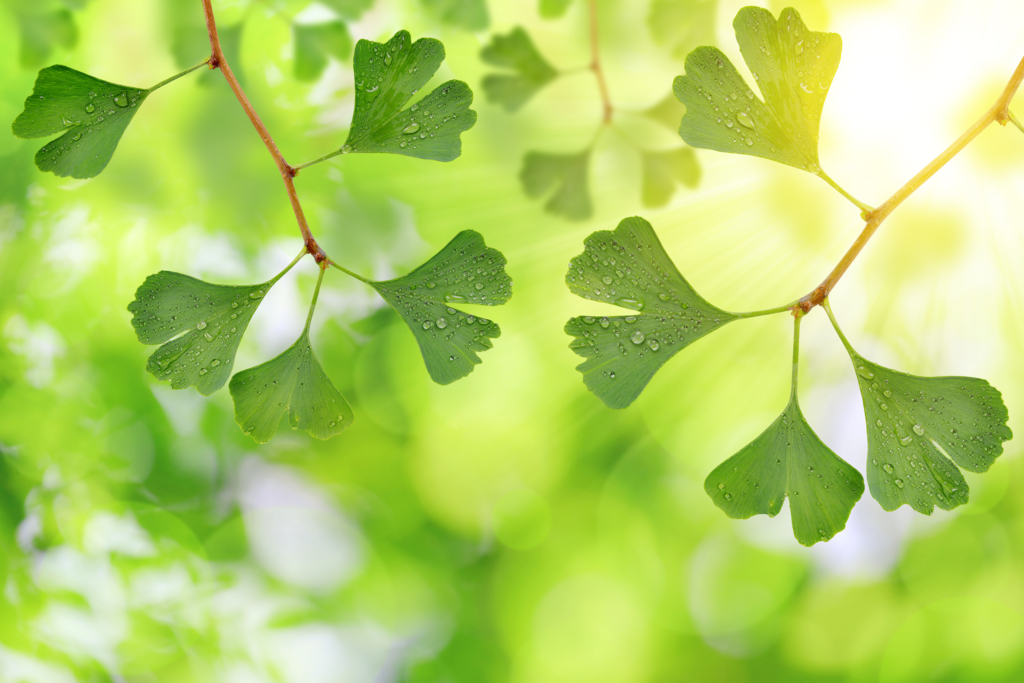
Ginkgo biloba – evolutionary biology meets modern skincare
Ginkgo biloba is considered one of the oldest plants still existing on Earth. As a so-called “living fossil,” it has existed virtually unchanged for over 200 million years. Its extraordinary resistance to environmental stress, pests, and extreme climatic conditions makes it not only botanically fascinating, but also highly interesting from a cosmetic perspective.
Its leaves have been used traditionally for more than 2000 years – first in Asian medicine, later also in Europe. Today, standardized ginkgo biloba extract is an integral part of high-quality cosmetic formulations.
Botany and natural origin
Ginkgo biloba is dioecious and the last representative of its botanical order. Its fan-shaped, often two-part leaves are typical and are symbolically associated with the yin-yang principle.
Cultivation and harvest
- Propagation via cuttings to ensure consistent quality
- Undemanding and pest-resistant
- Sensitive to waterlogging
- Harvested in late summer or fall when the leaves are still green
- Gentle air drying to preserve the active ingredients
- Standardized extraction (acetone-water process) in accordance with the European Pharmacopoeia
Targeted purification removes unwanted components such as ginkgolic acids and enriches the relevant active ingredients.
Active ingredients of ginkgo extract
- Flavonoids
- Quercetin
- Kaempferol
- Isorhamnetin
Properties:
- Strong antioxidant
- Protection against free radicals
- Stabilization of cellular structures
- Terpenelactones
- Ginkgolides
- Bilobalide
These components are particularly known for their microcirculation-promoting properties and make the extract particularly valuable in terms of functionality.
Effect in and on the skin of Ginkgo biloba
The cosmetic relevance of ginkgo biloba is based on several mechanisms:
Antioxidant protection
Free radicals are caused by UV radiation, environmental pollution, and stress. The flavonoids contained in ginkgo biloba act as radical scavengers and can reduce oxidative cell stress. This makes the extract particularly suitable for anti-aging and urban skin concepts.
Supports microcirculation
Ginkgo biloba is traditionally associated with circulation-promoting properties. In cosmetic applications, this can lead to:
- Vitalized skin appearance
- Better nutrient supply
- Fresh radiance
.
Barrier stabilization
Antioxidant protection and improved skin nourishment can indirectly contribute to strengthening the skin barrier—especially in mature or stressed skin.
Formulation approaches in modern cosmetics
Ginkgo biloba extract is versatile:
- Serums for revitalization
- Anti-aging emulsions
- Eye care products
- Masks in combination with plant oils
- Toning cleansing products
- Scalp products to support microcirculation
Synergistic combinations:
- Vitamin C derivatives
- Niacinamide
- Hyaluronic acid
- Peptides
- Caffeine
Possibilities and regulatory limits
Possibilities:
- Antioxidant claim
- Protection against environmental stress
- Support for a vital complexion
- Care for mature or dull skin
Limits:
- No medicinal claims (e.g., treatment of circulatory disorders)
- Compliance with standardized extract qualities
- Control of ginkgolic acid content
- Sensitization potential at very high concentrations
Cosmetically, the focus is clearly on the preventive, protective, and revitalizing effects.
Conclusion Ginkgo biloba
Ginkgo biloba is a traditional, scientifically well-researched plant ingredient with high cosmetic relevance. Its antioxidant properties, support of microcirculation, and symbolic power as the “tree of life” make it a powerful component of modern, nature-inspired skin care concepts.
It combines botanical history with regulatory standardized extraction and evidence-based application in skin care.
New products for your brand with Ginkgo biloba
For a quick market entry, Tojo Cosmetics offers immediately available, EU-compliant white label products in which this active ingredient is already formulated.
For individual production orders, Cosactive offers formulation-tested active ingredient mixtures starting from small quantities.
At our partner company Cosmacon, we are happy to assist you with individual product developments using this innovative active ingredient.
Just ask us!
Literature:
- European Pharmacopoeia (Ph. Eur.) – Monograph Ginkgo folium
- Ude, C., et al. (2013). Flavonoids in Ginkgo biloba – Chemistry, Analysis and Biological Activity.
- Smith, J. V., Luo, Y. (2004).Studies on Molecular Mechanisms of Ginkgo biloba Extract.
- Dermatological literature on the antioxidant effect of plant extracts.