
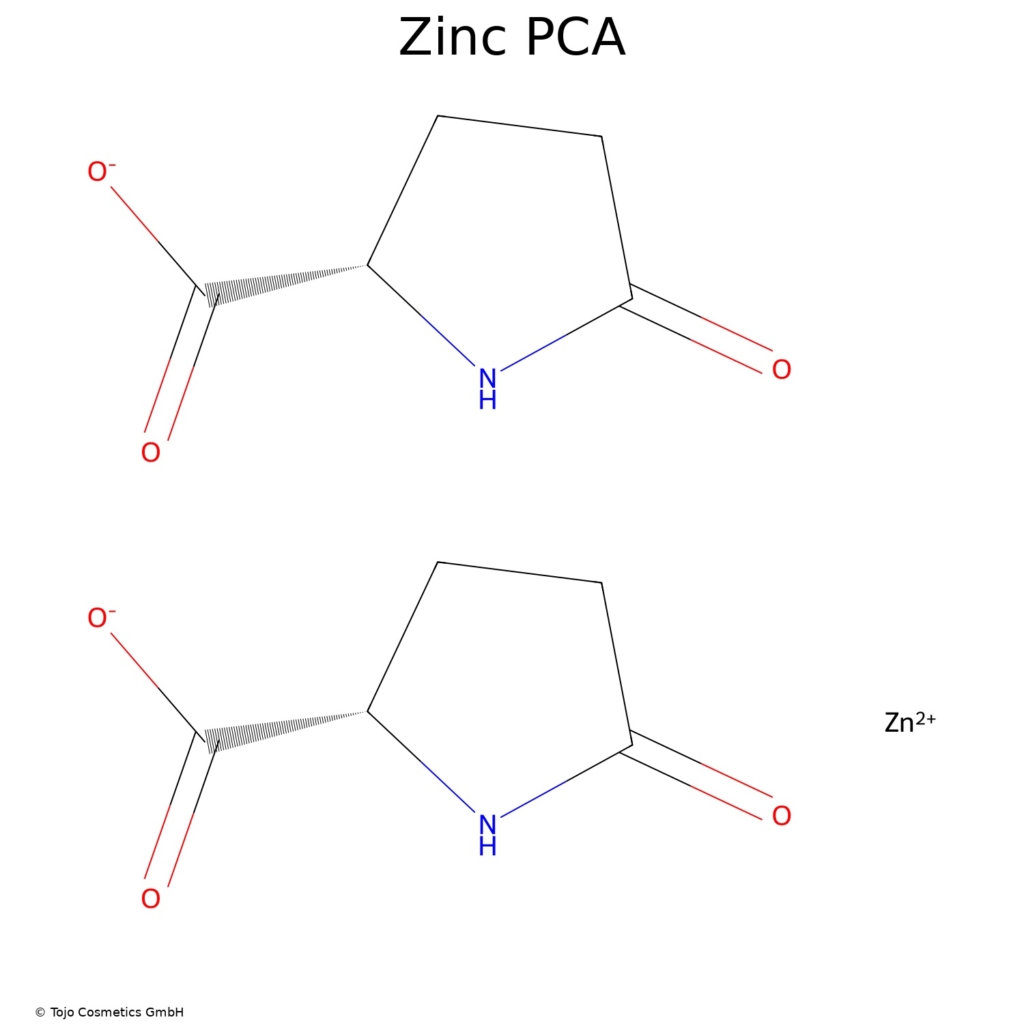
Zinc PCA in Cosmetics: Effects, Formulation, and Regulatory Requirements
Short Answer/Definition: Zinc PCA (INCI: Zinc PCA) is the zinc salt of pyrrolidone carboxylic acid (PCA), a natural component of the skin’s “Natural Moisturizing Factor” (NMF). The active ingredient combines the sebum-regulating properties of zinc with the moisture-binding properties of PCA. In cosmetic formulations, zinc PCA is primarily used in products for oily, blemished, or acne-prone skin. Typical concentrations range from 0.1% to 1.0%.
What is zinc PCA from a chemical perspective?
Zinc PCA is a salt composed of zinc ions (Zn²⁺) and L-pyrrolidone carboxylate (PCA).
The latter is a natural component of the skin’s Natural Moisturizing Factor (NMF) and acts as a hygroscopic moisture-retaining factor. When combined with zinc, it forms an active ingredient that simultaneously addresses hydration and sebum regulation.
Brief characterization:
| Parameter | Description |
|---|---|
| INCI | Zinc PCA |
| CAS | 15454-75-8 |
| Chemical class | Metal amino acid derivative |
| Solubility | Water-soluble |
| Typical dosage | 0,1–1,0 % |
What effect does zinc PCA have on the skin?
Zinc PCA has sebum-regulating, antimicrobial, and mildly anti-inflammatory effects.
Typical effects in cosmetic formulations:
- Reduction of excessive sebum production
- Support of the skin barrier
- Improvement in skin feel for oily skin
- Antimicrobial effect against skin-relevant microorganisms
Sebumeter measurements have shown that the application of 1% zinc PCA over several weeks can result in a measurable reduction in sebum production.
Why is zinc PCA particularly beneficial for acne-prone skin?
Zinc plays an important role in skin metabolism and in the enzymatic processes of the skin barrier.
Cosmetic relevance:
- Inhibition of sebum-associated skin processes
- Support of skin microbiome balance
- Improvement of the appearance of oily skin
For this reason, zinc PCA is frequently used in acne serums, facial toners, and clarifying skincare products.
What antimicrobial properties does zinc PCA possess?
Zinc ions can inhibit the growth of certain microorganisms.
Typical microbiological effects:
- Inhibition of Staphylococcus aureus
- Inhibition of Cutibacterium acnes
- Inhibition of Malassezia furfur
These properties make Zinc PCA particularly interesting for:
- Acne care
- Scalp care
- Deodorant formulations
In which cosmetic products is Zinc PCA used?
The active ingredient is versatile.
Typical applications:
- Facial toners for oily skin
- Anti-acne serums
- Mattifying day creams
- Scalp tonics
- Shampoos for oily scalps
- After-sun products
- Makeup formulations
Zinc PCA can be used in both leave-on and rinse-off products.
What are the challenges when formulating with zinc PCA?
Zinc ions tend to form insoluble complexes with certain anions. This can lead to cloudiness or precipitation.
Typical formulation issues:
- Complex formation with phosphates
- Reaction with carbonates
- Interactions with chelating agents
- Precipitation with certain polymer structures
Practical guide for formulators:
- Set the pH range between 4.5 and 6.5.
- Avoid phosphate buffers.
- Check electrolyte stability
- Test metal ion compatibility
- Conduct stability testing over 12–24 months.
These aspects are crucial in the practical development of cosmetic formulations.
What synergistic combinations with metal-PCA are possible?
Multiple metal ions can be used together to support physiological skin processes.
An example of such a combination is a mixture of:
PHYSIOGENYL® Powder
- Maltodextrin
- Sodium PCA
- Magnesium PCA
- Zinc PCA
- Manganese PCA
This combination combines:
- Moisturizing factors
- Trace elements
- Enzymatic cofactors
Such systems are frequently used in skin-physiologically oriented care products.
How is Zinc PCA classified from a regulatory perspective?
Zinc PCA is permitted for cosmetic use in the European Union.
Regulatory key points:
- INCI: Zinc PCA
- CAS Number: 15454-75-8
- No restrictions under Regulation (EC) No. 1223/2009
- Safety assessment is conducted for the finished product
As part of the CPSR, the following points, among others, must be evaluated:
- Exposure
- Purity of the raw material
- Heavy metal content
- Stability of the final formulation
We are pleased to work with these zinc PCA-containing active ingredients:
| Handelsname | Lieferant | INCI-Bezeichnung | Bemerkung |
|---|---|---|---|
| Reaqua Zinc PCA | Guangzhou Reachin Chemical Co., Ltd. | Zinc PCA , Aqua | |
| Zinc PCA | Alpha Environmental | Zinc PCA | |
| Zinc PCA | COSROMA | Zinc PCA | |
| Zinc PCA | Suzhou Greenway Biotech Co., Ltd. | Zinc PCA | |
| iMoist Zinc PCA | KimiKa, LLC (ehemals Cosphatech) | Zinc PCA | |
| Zinc Pyrrolidone Carboxylic Acid | Shanghai Oli Enterprises Co., Ltd | Zinc PCA | |
| Zincidone | Solabia-Gruppe | Zinc PCA | |
| Natori ZPCA 95 | Ecoori | Zinc PCA | |
| ILLUMISCIN | Rahn AG | Glycerin , Aqua (Aqua) , Olea Europaea (Olive) Leaf Extract , Ascorbyl Glucoside , Zinc PCA , Ascorbic Acid | |
| EcoCar Zinclean | Ecochem Specialities Ltd. | Zinc PCA | |
| AJIDEW ZN-100 | Ajinomoto OmniChem | Zinc PCA | |
| AJIDEW ZN-100N | Ajinomoto OmniChem | Zinc PCA | Zertifiziert für Naturkosmetik |
| PHYSIOGENYL Powder | Solabia-Gruppe | Magnesium PCA , Manganese PCA , Zinc PCA , Sodium PCA | |
| PHYSIOGENYL | Solabia-Gruppe | Sodium PCA , Magnesium PCA , Zinc PCA , Manganese PCA | |
| SHAROHYAL OLIGO | Sharon Personal Care Srl | Aqua , Glycerin , Lentinus Edodes Extract , Tremella Fuciformis (Mushroom) Extract , Zinc PCA , Copper PCA | |
| PRODEW 700 | Ajinomoto OmniChem | Sodium PCA , Glutamic Acid , Aqua , Sodium Polyaspartate , Butylene Glycol , Betaine , Zinc PCA , Sodium Citrate , Arginine , Serine , Lysine HCl |
Conclusion: Zinc PCA
For rapid market entry, Tojo Cosmetics offers EU-compliant white-label products that are already formulated with sebum-regulating active ingredients such as zinc PCA.
For custom product development, Cosactive offers formulation-tested active ingredients and functional blends starting at low usage levels.
During development, pH stability, electrolyte compatibility, and the target product should be taken into account. If you are interested in custom formulation development, please feel free to contact Cosmacon.
FAQ
What is zinc PCA?
Zinc PCA is a zinc salt of pyrrolidone carboxylic acid and a component of modern, sebum-regulating skincare.
What is the effect of zinc PCA?
It reduces excess sebum, supports the skin barrier, and possesses antimicrobial properties.
Is zinc PCA suitable for acne?
Yes, the active ingredient is frequently used in skincare products for oily and acne-prone skin.
Is zinc PCA permitted in the EU?
Yes, the active ingredient is cosmetically approved and listed without restrictions.
What concentrations are used?
Typical concentrations range between 0.1 and 1.0%.
Why is zinc PCA difficult to formulate?
Zinc ions can form insoluble complexes with other anions.
Does every product containing zinc PCA require a CPSR?
Yes, since every cosmetic formulation requires its own safety assessment.
References:
-
- Gupta M, Mahajan VK, Mehta KS, Chauhan PS.
Zinc therapy in dermatology: A review
Dermatol Res Pract. 2014;2014:709152. - Dreno B, Moyse D, Alirezai M, Amblard P, Auffret N, Beylot C, et al.
Multicenter randomized comparative double-blind controlled clinical trial of the safety and efficacy of zinc gluconate versus minocycline hydrochloride in the treatment of inflammatory acne vulgaris
Dermatology. 2001;203(2):135–140. - Gupta M, Mahajan VK, Mehta KS, Chauhan PS.
Zinc therapy in dermatology: A review
Dermatol Res Pract. 2014;2014:709152. - Bae YS, Hill ND, Bibi Y, Dreiher J, Cohen AD.
Innovative uses for zinc in dermatology
Dermatol Clin. 2010;28(3):587–597.
- Gupta M, Mahajan VK, Mehta KS, Chauhan PS.