
Brief Definition
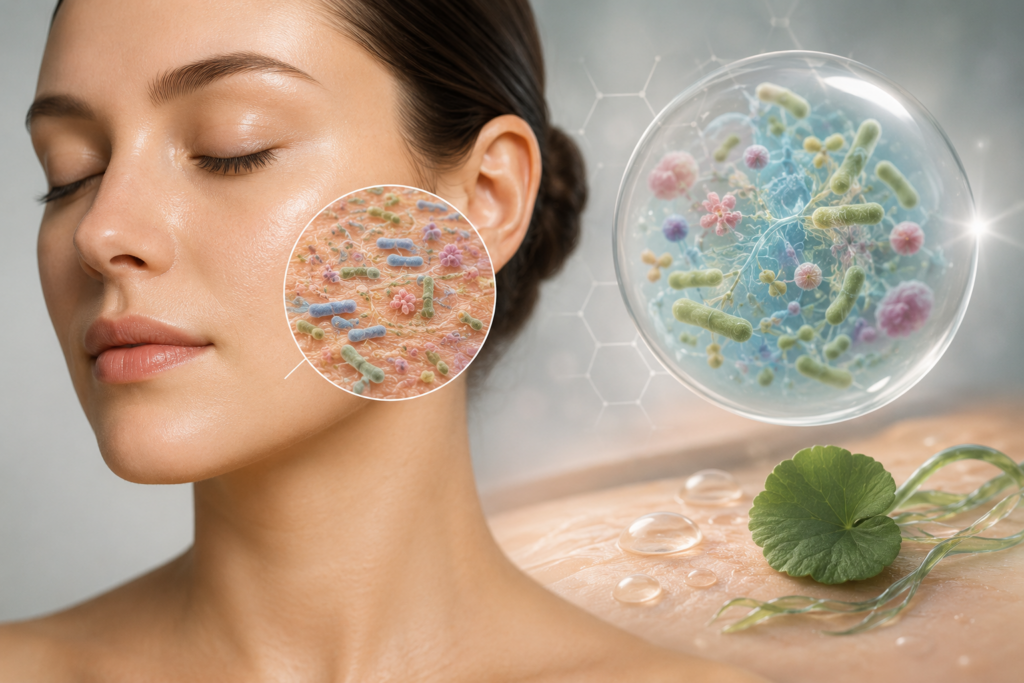
The skin microbiome refers to the totality of all microorganisms on the skin, including their functional potential—that is, their genetic information and metabolic activities.
It is an integral part of the skin’s surface and interacts closely with pH, lipids, moisture, and the skin’s barrier function. This topic is relevant in cosmetics because formulations can influence this balance. Claims regarding this are permissible, but they must align with the cosmetic intended use and be supported by robust evidence.
What exactly is the Skin Microbiome 2026?
The Skin Microbiome 2026 encompasses all microorganisms on the skin as well as their functional properties. It is not merely a list of microbes, but a dynamic system that responds to external influences.
Definition of terms:
– Microbiota: Living microorganisms
– Microbiome: Microorganisms + genetic/biological functions
– Eubiosis: State of balance
– Dysbiosis: Imbalance
– Prebiotics: Nutrients for microorganisms
– Probiotics: Living microorganisms
– Postbiotics: Inactive microorganisms or their components
Which microorganisms are part of the Skin Microbiome 2026?
The Skin Microbiome 2026 consists primarily of bacteria and fungi, as well as other microorganisms to a lesser extent.
Typical representatives:
- Staphylococcus
- Cutibacterium
- Corynebacterium
- Malassezia
Important: The composition depends heavily on the skin region, skin type, and individual factors.
Why is the skin microbiome relevant to cosmetics?
Cosmetic products influence the skin environment and thus indirectly also the skin microbiome.
Relevant influencing factors:
- pH value
- Moisture
- Lipid film
- Cleansing
- Preservative system
This relationship plays a particularly significant role in cases of sensitive skin, acne, the scalp, or deodorant products.
Will the skin microbiome be the same for everyone in 2026?
No, the skin microbiome will differ in 2026:
- between different parts of the body
- between individuals
Moist, sebum-rich, and dry skin areas each exhibit completely different microbiological profiles.
Are there “good” and “bad” microorganisms?
No, not across the board. The skin microbiome functions as a balanced system.
A microorganism can be:
- neutral
- supportive
- or problematic under certain conditions.
The context is always decisive, not the species itself.
How can cosmetics support the skin microbiome?
The goal is not to alter the system, but to stabilize it.
Typical approaches:
- mild cleansing systems
- pH-balanced formulations
- humectants
- barrier-strengthening lipids
- balanced preservation
Optional:
- prebiotics
- postbiotics
- ferments
Which raw materials are relevant for the skin microbiome in 2026?
The following raw materials are particularly relevant:
– Prebiotics: promote favorable conditions
– Postbiotics: support skin condition
– Ferments: improve skin feel
– Humectants: stabilize the skin environment
– Mild surfactants: reduce stress on the skin
Probiotic systems are possible but technologically and regulatory challenging.
What claims are possible for the skin microbiome in 2026?
Cosmetic claims that do not suggest a medical effect are permitted.
Typical permissible claims:
- “Supports the skin’s natural balance”
- “Protects the skin microbiome”
- “Contributes to a skin-friendly environment”
- “Microbiome-friendly” (only with evidence)
- “Supports the skin barrier”
Which of these statements are problematic or impermissible?
Statements of a medical nature are not permitted.
Problematic claims:
- “cures dysbiosis”
- “treats skin diseases”
- “eliminates harmful germs”
- “has an antibacterial/antiviral effect” as the main effect
- “completely restores the microbiome”
How must claims regarding the skin microbiome be substantiated in 2026?
A robust claim strategy is based on several levels:
Typical testing strategy:
- Definition of the claim
- Selection of suitable test methods
- Testing on the final product
- Assessment of cosmetic relevance.
Possible metrics:
- Skin moisture
- TEWL
- pH value
- Tolerability
- Microbial parameters
- Evidence for a single raw material is generally not sufficient.
Does preservation automatically have a negative impact on the skin microbiome?
No, a blanket negative effect cannot be substantiated.
What is important:
- correct selection
- appropriate dosage
- tailored formulation
Preservation primarily serves to protect the product and is required by regulations.
How do you develop a product for the skin microbiome in 2026?
A successful concept arises from the combination of product idea, formulation, and claim.
Step by step:
- Define the target audience
- Determine the product function
- Select suitable raw materials
- Integrate preservation
- Develop a claim strategy
- Define a testing concept
Practical implementation
For market entry, it may be advisable to rely on existing, microbiome-oriented formulations. Tojo Cosmetics offers white-label cosmetic products that have already been developed and evaluated for EU compliance.
For custom developments, Cosactive provides innovative active ingredients and functional raw material systems that have been tested in formulations and are also available in smaller quantities. In practice, it is crucial that the formulation, claims, testing strategy, and regulatory evaluation are coordinated from the very beginning—especially for microbiome-related claims.
At our partner company Cosmacon, we are happy to assist you with custom product development for the skin microbiome.
Just ask us now!
FAQ
What is the skin microbiome?
A complex system of microorganisms and their functions on the skin.
Is the skin microbiome the same for everyone?
No, it varies greatly depending on skin type, body area, and life stage.
What does “microbiome-friendly” mean?
A product does not negatively affect the skin environment and supports its balance.
Are probiotics necessary in cosmetic products?
No, postbiotics or other systems are often more practical.
Which claims can be safely made?
Primarily those that describe support or balance, rather than therapy.
Does every microbiome product require special testing?
Yes, the claim must always be backed by appropriate data.
Is preservation bad for the skin microbiome?
No, it is necessary for product safety and must be formulated correctly.