
Acetylglucosamine in Cosmetics – Properties, Effects, and Formulations
At a Glance
N-Acetylglucosamine (INCI: Acetyl Glucosamine) is an amino sugar that serves as a building block for important biological structures such as hyaluronic acid and glycosaminoglycans. In cosmetic formulations, it is used to support skin hydration, barrier function, and skin structure. The active ingredient is water-soluble, well-tolerated by the skin, and is frequently used in concentrations between 1–5%. Its effects are based, among other things, on promoting hyaluronic acid synthesis and modulating skin renewal.
What is acetylglucosamine from a chemical perspective?
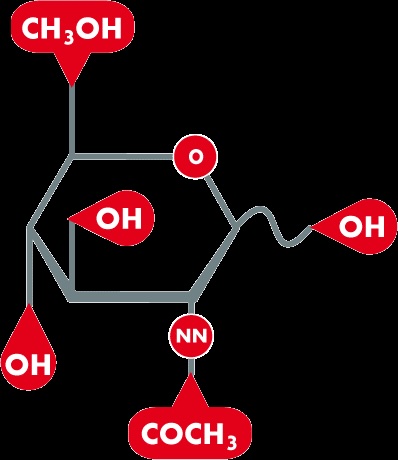
Acetylglucosamine is a derivative of glucose with an acetyl-amino group.
Physicochemical properties
| Parameter | Description |
|---|---|
| Chemical formula | C8H15NO6 |
| Molecular weight | 221.21 g/mol |
| INCI | Acetylglucosamine |
| Solubility | Highly water-soluble |
| pH stability | Stable in the range of approx. 4–7 |
| Source | Biotechnological or derived from chitin |
The active ingredient is a component of many biological macromolecules, including:
- Hyaluronic acid
- Chitin
- Glycoproteins
- Proteoglycans
- What role does acetylglucosamine play in the human body?
Acetylglucosamine is a structural component of numerous cellular structures.
Biological functions
- Building block of hyaluronic acid
- Component of the extracellular matrix
- Involvement in cell communication
- Structural component of cartilage and connective tissue
These functions explain the interest in cosmetic applications.
What effect does acetylglucosamine have on the skin?
The active ingredient supports several physiological processes in the skin.
Cosmetically relevant effects
- Promotion of hyaluronic acid synthesis
- Improvement of skin hydration
- Support of the skin barrier
- Contribution to a more even skin texture
Studies show that topical applications can improve skin hydration and skin appearance.
Which studies describe the effects of acetylglucosamine?
Several dermatological studies have investigated the active ingredient.
Results from studies
- Improved skin hydration after several weeks of use
- Support of epidermal hyaluronic acid production
- Visible improvement in skin texture
These effects are described in dermatological studies on amino sugar derivatives.
What combinations with other active ingredients are beneficial?
The active ingredient shows interesting synergies with other cosmetic active ingredients.
Typical active ingredient combinations
- Niacinamide – supports the skin barrier
- Hyaluronic acid – enhanced moisturizing effect
- Peptides – supports skin structure
- Ceramides – barrier strengthening
- Panthenol – soothing care
Such combinations are frequently used in modern skincare formulations.
Are there applications for acetylglucosamine in hair care?
The active ingredient is also being investigated in hair care formulations.
Potential effects
- Support of the scalp barrier
- Improvement of scalp hydration
- Possible support of the hair follicle environment
Studies are also investigating the role of amino sugars in hair follicle metabolism.
Which cosmetic products can contain acetylglucosamine?
The active ingredient is suitable for many product categories.
Typical applications
- Anti-aging serums
- Moisturizing creams
- Barrier-repairing skincare
- Scalp serums
- Soothing masks
What are some useful example product formulations?
Here are some typical product ideas:
1. Hydration Serum
• Acetyl Glucosamine – 3%
• Hyaluronic Acid – 0.3%
• Panthenol – 1%
2. Barrier-Repairing Cream
• Acetyl Glucosamine – 2%
• Ceramides – 0.5%
• Niacinamide – 4%
3. Anti-aging serum
• Acetyl glucosamine – 3%
• Peptide complex – 2%
• Hyaluronic acid – 0.2%
4. Scalp serum
• Acetyl glucosamine – 2%
• Niacinamide – 3%
• Panthenol – 1%
5. Soothing Face Mask
• Acetyl Glucosamine – 3%
• Bisabolol – 0.2%
• Aloe Extract – 2%
How is acetyl glucosamine classified under EU regulations?
The active ingredient is permitted for use in cosmetics.
Regulatory Key Points
- INCI: Acetyl Glucosamine
- Not listed in Annexes II–VI of the EU Cosmetics Regulation
- Safety assessment is conducted as part of the overall product
An individual safety assessment must be performed for each product.
Conclusion: N-Acetylglucosamine
For rapid market entry, Tojo Cosmetics offers EU-compliant white-label products that are already formulated with modern moisturizing and barrier ingredients.
For custom formulations, Cosactive offers formulation-tested active ingredients and innovative raw material combinations starting at low usage levels.
When developing products with acetylglucosamine, particular attention should be paid to stability, pH range, and active ingredient combinations. Feel free to contact Cosmacon if you would like to have custom, highly effective products manufactured with N-acetylglucosamine.
FAQ
What is acetylglucosamine in cosmetics?
An amino sugar that serves as a building block of hyaluronic acid and is used in skincare products.
What effect does acetylglucosamine have on the skin?
It supports skin hydration and can improve skin texture.
Is acetylglucosamine a component of hyaluronic acid?
Yes, it is a structural building block of this polysaccharide.
What concentrations are used?
Concentrations typically range from 1% to 5%.
Can acetylglucosamine be combined with niacinamide?
Yes, this combination is frequently used in skincare formulations.
Is acetylglucosamine permitted in the EU?
Yes, the active ingredient is approved for use in cosmetics.
Does every product containing acetylglucosamine require a CPSR?
Yes, every cosmetic formulation requires its own safety assessment.
References
-
- Bissett DL, Oblong JE, Berge CA.
Niacinamide: A B vitamin that improves aging facial skin appearance
Dermatol Surg. 2005;31(7 Pt 2):860–865. - Kimball AB, Kaczvinsky JR, Li J, Robinson LR, Matts PJ, Berge CA.
Reduction in the appearance of facial hyperpigmentation by topical N-acetyl glucosamine
J Cosmet Dermatol. 2010;9(1):20–26. - Bissett DL, Robinson LR, Raleigh PS, Miyamoto K, Hakozaki T, Li J, et al.
Reduction in the appearance of facial hyperpigmentation by topical N-acetyl glucosamine and niacinamide
J Cosmet Dermatol. 2006;5(4):309–315.
- Bissett DL, Oblong JE, Berge CA.