
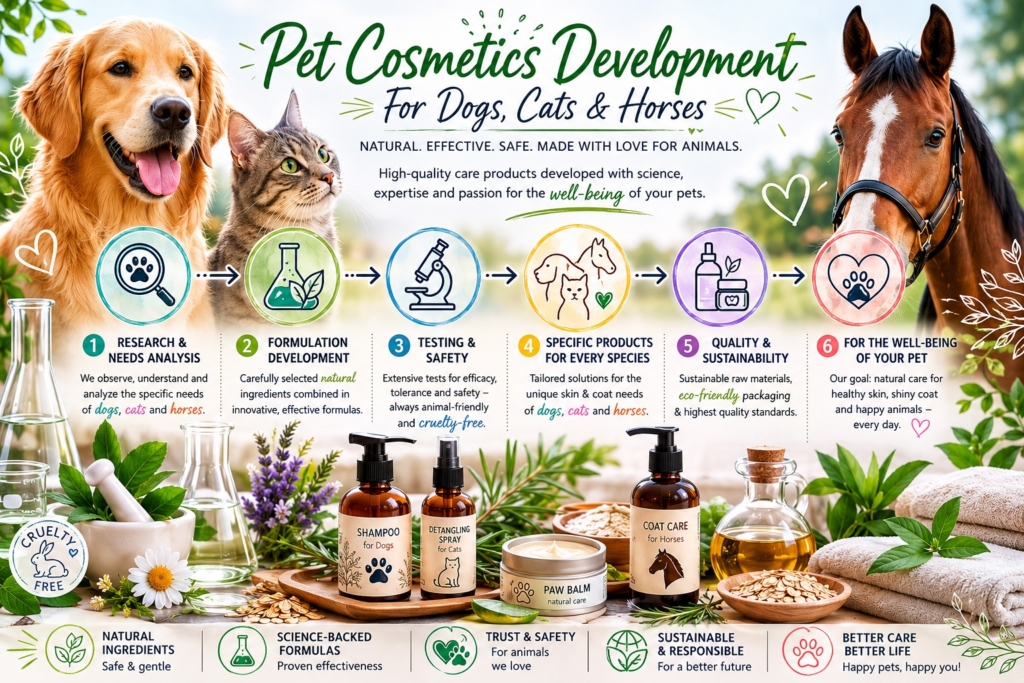
When people first encounter pet care product development, they often assume: “It’s just cosmetics — but for animals.” This assumption is understandable, but fundamentally wrong. Pet care products operate under different legal frameworks, require deep biological knowledge of animal skin, coat and microbiome — and in the worst case, an ill-conceived formula can cause discomfort or irritation to the very animal it was meant to help. At Tojo cosmetics, pet care product development is therefore an independent, scientifically grounded process — far removed from simply adapting human cosmetic formulas for the pet market.
Legal Framework: Pet Care Products Are Not Cosmetics
The first and most important difference lies in the law. In Germany — and by extension across the EU — pet care products are not subject to the Cosmetics Regulation (EC) No. 1223/2009, which applies exclusively to products intended for use on humans.
Instead, pet grooming and care products fall under § 2 (6) No. 7 LFGB (German Food and Feed Code), classified as “household cleaning and care products” and treated as ordinary consumer goods. This means: no mandatory approval procedure, no prescribed safety assessment following the cosmetic model, and no mandatory INCI labelling — provided the product is intended exclusively for external application on animals for cleaning, care, or altering appearance or body odour, and contains no substances used in prescription veterinary medicines or biocides (Federal Office of Consumer Protection and Food Safety, LFGB § 2 (6) No. 7).
Additionally, the CLP Regulation (EC) No. 1272/2008 applies: if a pet care product contains classified hazardous ingredients above certain threshold values, it must be labelled with the appropriate hazard pictograms and warning statements.
Important distinction: EU legislation clearly differentiates between companion animals (including horses kept for personal enjoyment) and livestock. Livestock are subject to considerably stricter regulations in many cases. The following discussion applies exclusively to the companion animal sector.
This legal independence means more freedom for formulators — but also more personal responsibility. There is no EU-wide positive list of “permitted pet cosmetic ingredients.” Instead, every formulation must be independently assessed for compatibility, safety and efficacy.
What Really Distinguishes Animal Skin from Human Skin
At first glance, skin appears similar across species: dogs, cats and horses all have skin composed of epidermis, dermis and subcutis, and basic immune mechanisms show considerable similarities to those in humans (Marx & Provost, SÖFW Journal 6/2026; Hnilica & Patterson, 2017). The good news: skin care effects demonstrated in humans can in principle be transferred to animals.
But the devil is in the details — and those details have decisive consequences for pet care product development.
Skin pH: An Underestimated Factor
Skin pH varies considerably between species:
| Species | Skin pH |
|---|---|
| Human | approx. 5.5 |
| Dog | approx. 5.5–7.0 |
| Cat | approx. 6.0–7.0 |
| Horse | approx. 7.0–7.3 |
An off-the-shelf human shampoo with pH 5.5 is therefore potentially harmful for dogs and horses: recent studies show that an acidic pH can damage the lipid and skin barrier of animals, leading to irritation and secondary infections (Shimada et al., 2009). Adjusting the pH to match the species is not a refinement — it is a basic requirement for a safe product.
Sebaceous and Sweat Glands: Why Animals Need More Time
Humans have significantly more sebaceous and sweat glands than dogs, cats or horses. These enable a comparatively rapid rebuilding of the natural, protective sebum layer after washing. In animals, this regeneration process takes considerably longer — an argument that feeds directly into the formulation strategy: pet care products must be milder, actively support the skin barrier and ideally provide long-lasting protection, as many animals are bathed far less frequently than humans.
The Coat: Protective Layer and Formulation Barrier
The coat protects animal skin from UV radiation, pressure and environmental influences — but simultaneously acts as a barrier for active care ingredients. Pet care product development must therefore account for the fact that skin care products need to penetrate the coat before they can act on the skin surface. Brushing the coat against the grain and using thinly spreading formulations — oils or light emulsions — is recommended for effective application.
The Microbiome: Similar Genera, Different Species
The skin microbiome of dogs, cats and horses contains many of the same microbial genera as humans — Staphylococci, Corynebacteria, Malassezia — but differs significantly at species level. Research shows that the microbiome of pets living closely with humans gradually shifts to resemble the human microbiome (Song et al., 2013). For formulators this means: surfactants and emulsifiers that work well in human products may affect the more sensitive animal microbiome more than expected.
Ingredients: What Works — and What Doesn’t
One of the most common mistakes in pet care product development is reaching uncritically into the human cosmetics raw material palette. An ingredient being harmless for humans does not mean it is suitable for all animal species.
Neem oil is a prominent example: widely used and valued in care products for dogs and horses — yet toxic to cats. These species-specific restrictions must be explicitly checked for every formulation.
At Tojo cosmetics, our formulation approach is built on:
- Natural actives and emollients that are toxicologically assessed under cosmetics law and therefore generally suitable for use in animal care.
- Anti-inflammatory raw materials such as plant-based adaptogens or bioactive compounds that modulate inflammatory mechanisms.
- Structure-strengthening emollients with membrane-stabilising effects on the lipid bilayers of the skin barrier.
- Low-emulsifier or emulsifier-free formulations, as surfactants and classic emulsifiers can interfere with the lipid structure of the skin barrier and weaken it (Marx & Provost, SÖFW Journal 6/2026).
- Omega-3 fatty acids (EPA, DHA) — especially for horses with summer eczema, as they demonstrably strengthen the skin barrier function (Schreiber et al., 2008).
Specific Application Areas in Pet Care
Pet care product development is not monolithic — it differentiates by body area and species:
Cleansing: Mild cleansing products with a species-appropriate pH that emulsify skin fat without extracting sebum from the skin. The coat structure should be preserved as much as possible.
Skin and coat care: Lightly spreading products that reach both the coat and the underlying skin. Silicone-free detanglers without an oily film are now standard in modern formulations — classic silicones are increasingly being replaced by more environmentally compatible, natural alternatives.
Paw care: The primary goal is preventing cracking caused by dryness, road salt or irritated skin. In addition to natural emollients, soothing, barrier-strengthening actives and adaptogens provide added value.
Hoof care: Seasonal requirements differ: in summer, protection from drying out is paramount; in winter, protection from excessive moisture absorption and softening of the hoof horn.
Nose and ear care: Particularly for lightly pigmented animals — pale noses in dogs, pink muzzles in horses — sun protection can be medically necessary. Ear care products must be formulated to avoid spreading too deeply into the ear canal.
A Growing Market — and Rising Standards
The global pet care market is growing continuously: according to Mintel and Euromonitor, pets in Europe and North America have long since transitioned from “utility animals” to family members. This is reflected in rising spending on premium pet products, growing interest in natural ingredients and — increasingly — more discerning consumers who read labels and question what’s in them (Mintel Pet Care Report, 2023).
For manufacturers, this means: pet care product development is becoming more professional, more scientific and more transparent. Those who rely on human cosmetics know-how without understanding the physiological differences between species risk producing not just ineffective — but in the worst case, harmful — products.
Conclusion Pet Care Product Development: Pet Care Requires Its Own Expertise
Pet care product development is neither a simplified version of human cosmetics nor a niche field governed by clear regulations. It demands the best of both worlds: scientific knowledge of skin biology, microbiome and physiology — combined with a deep understanding of the legal independence of this product category.
At Tojo cosmetics, we have developed this field with the same standards we apply to all our formulations: scientifically grounded, responsibly sourced and consistently aligned with the wellbeing of the animal. Because our furry family members deserve products truly made for them — not for us.
References
- Marx, U. & Provost, A. (2026): Development of Effective Pet Care Products: From Skin Research to Formulation. SÖFW Journal, Issue 6/2026, Vol. 152, pp. 42–45.
- Federal Office of Consumer Protection and Food Safety (BVL): LFGB § 2 (6) No. 7.
- Regulation (EC) No. 1272/2008 of the European Parliament and of the Council (CLP Regulation).
- Hnilica, K. A. & Patterson, A. P. (2017): Small Animal Dermatology: A Color Atlas and Therapeutic Guide. 4th edition. Elsevier.
- Matousek, J. L. et al. (2003): Evaluation of the effect of pH on in vitro growth of Malassezia pachydermatis. Canadian Journal of Veterinary Research, 67(1), pp. 56–59.
- Shimada, K. et al. (2009): Relationship between the in vitro germination of Malassezia pachydermatis and the skin surface pH of dogs. Veterinary Dermatology, 20(5–6), pp. 359–362.
- Song, S. J. et al. (2013): Cohabiting family members share microbiota with one another and with their dogs. eLife, 2:e00458.
- Schreiber, L. et al. (2008): Omega-3 fatty acids in equine dermatology. Equine Veterinary Journal, Supplement 35.
- Mintel Group Ltd. (2023): Global Pet Care Market Report.
- Euromonitor International (2023): Pet Care: Global Industry Overview.